Keep the community with you, and the work going.
Construction impacts are real: night works, road closures, trucks past the school gate. Projects that manage them openly keep their working hours. Projects that do not, lose them. We plan and run engagement from design through to handover, to the standard TfNSW, Sydney Metro and energy proponents expect.
What we deliver.
From the first notification to the last commitment closed out at handover.
01Engagement plans & obligations registers+
Engagement plans fail review when they are generic. Ours are traced clause by clause to the contract specification and the conditions of approval, with a stakeholder and obligations register built from the environmental assessment behind them.
- Community and stakeholder engagement plans traced clause by clause to the specification and conditions of approval
- Stakeholder and obligations registers built from the EIS, REF or social impact assessment
- Every commitment with an owner, a trigger and an evidence requirement
- Formatted for acceptance by the principal and, where required, the regulator
The plan passes review because it was written against the obligations — and it works on site because every commitment has a name against it.
02Extended hours community agreements (ICNG)+
Standard construction hours rarely fit the method. Under the NSW Interim Construction Noise Guideline and project out-of-hours works protocols, work outside standard hours can proceed where affected receivers are properly consulted — and in many cases, where they agree. That negotiation is a Commex specialty.
- Receiver-by-receiver identification of who is affected, by what works, and for how long
- Negotiated community agreements for extended and night works, documented property by property
- Respite offers, alternative accommodation programmes and make-good commitments
- Agreement evidence packaged for out of hours works approvals and environment protection licence variations
Done early, honestly and door by door, extended hours stop being a fight. On one TfNSW upgrade this work carried agreements with more than 300 properties.
03Notifications, doorknocks & project updates+
Most complaints begin as surprises. We run the notification programme — letters, doorknocks and project updates — so nobody learns about night works from the noise.
- Notification calendars aligned to the construction programme and approval timeframes
- Plain-language works notifications for night works, closures and detours
- Doorknocks for high-impact works, with a record kept for every property
- Project updates that report back on commitments kept, not just works coming
A community that has been told what is coming, and why, gives a project room to work.
04Complaints management & reporting+
A complaint answered well is engagement working. Answered late, it becomes a call to the regulator. We build and run the system: intake, response clocks, escalation, and the fix on site — not just the reply.
- Complaints procedures with response timeframes that meet the approval and licence requirements
- A root-cause loop to site, so the thing complained about actually changes
- Complaints registers and reporting to the principal and regulator
- Trend analysis that catches an issue while it is still one street wide
The complaints record is the first thing a regulator reads when a project asks for more hours. We keep it worth reading.
05Crisis & incident communications+
When something goes wrong — a spill, a struck service, a night of noise that was never notified — the first hours decide whether it stays an incident or becomes a story. We prepare the playbook before it is needed, and stand it up when it is.
- Holding statements and approved first responses, drafted before works start
- Notification flows matched to the project's incident and regulatory obligations
- One source of truth across site, principal and proponent communications teams
- Community follow-up and post-incident reporting that closes the loop
The projects that recover fastest are the ones the community heard from first.
06Facilitation, community sessions & hearing rooms+
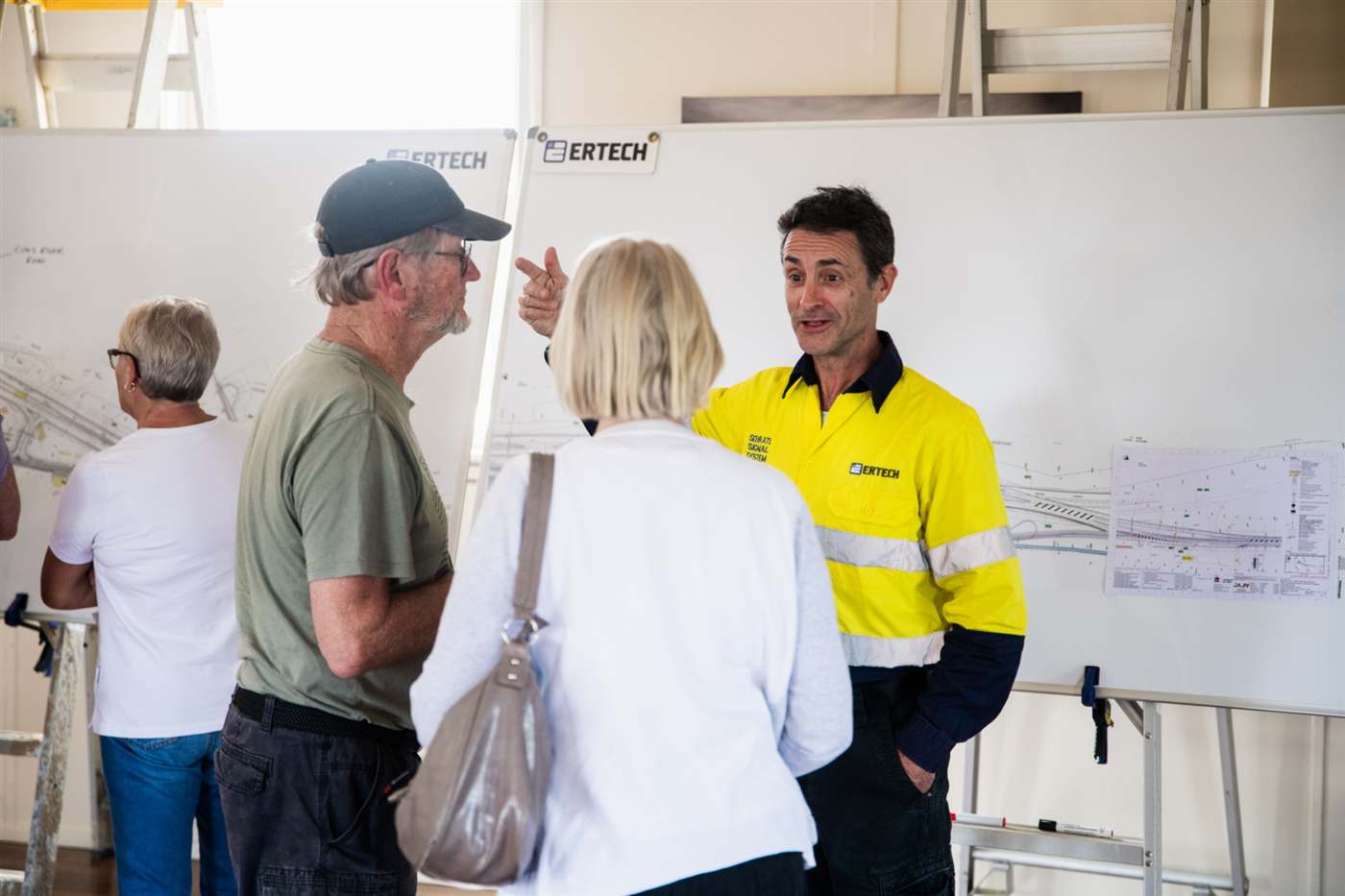
Some conversations need a room, not a letterbox. We design, staff and facilitate the sessions where a project meets its public — and we have sat on both sides of the hearing room.
- Community information sessions, drop-ins and pop-ups, designed and run end to end
- Community reference groups established and independently facilitated
- Hearing and submission support, with the consultation record presented properly
- Commitments captured in the room and routed straight into the obligations register
A well-run session takes the heat out of an issue. A badly run one becomes the issue.
07Access planning for critical facilities+
Closures are hardest on the people who cannot plan around them. We plan access for businesses, schools, emergency services and critical facilities before the detour goes in, not after the phone rings.
- Access plans for critical facilities, businesses, schools and emergency services during closures
- Business impact consultation with a record kept per premises
- Coordination with road authorities, councils and transport operators
- Special event and peak-period planning around the works programme
The measure of a good closure is who didn't have to call about it.
08Aboriginal participation & social procurement reporting+
Participation targets are commitments like any other: they need a plan, a record and a report. We run the reporting so the numbers are ready when the principal asks, not assembled after.
- Aboriginal participation plans and reporting against project targets
- Social procurement tracking and reporting
- Engagement coordinated with cultural heritage processes where the two meet
- Records kept to the standard an audit will apply
Reported quarterly with evidence behind every number — the way principals and agencies expect it.
09Social impact inputs & SIA support+
Social impact assessment shapes the conditions a project will live under for years. We provide the inputs during assessment, and then make the commitments deliverable during construction.
- Social impact inputs and SIA support aligned with the NSW Social Impact Assessment Guideline
- Social baseline and community profile inputs
- Mitigation and enhancement measures written to be deliverable on site
- SIA commitments converted into the engagement plan and obligations register
An SIA commitment that cannot be delivered becomes a non-conformance. We write them so they can be.